
A year ago, most business AI answered questions. Now it finishes tasks. That shift is the story of AI automation in 2026, and it changes what a small or mid-sized business should build first.
What changed in AI automation this year
Assistants act, not just reply. Phone assistants now order, book and reschedule across apps, and that capability is rolling out in more countries, including India, the UK and Japan. Business tools are following: agents that take a long task, work through it step by step, and report back.
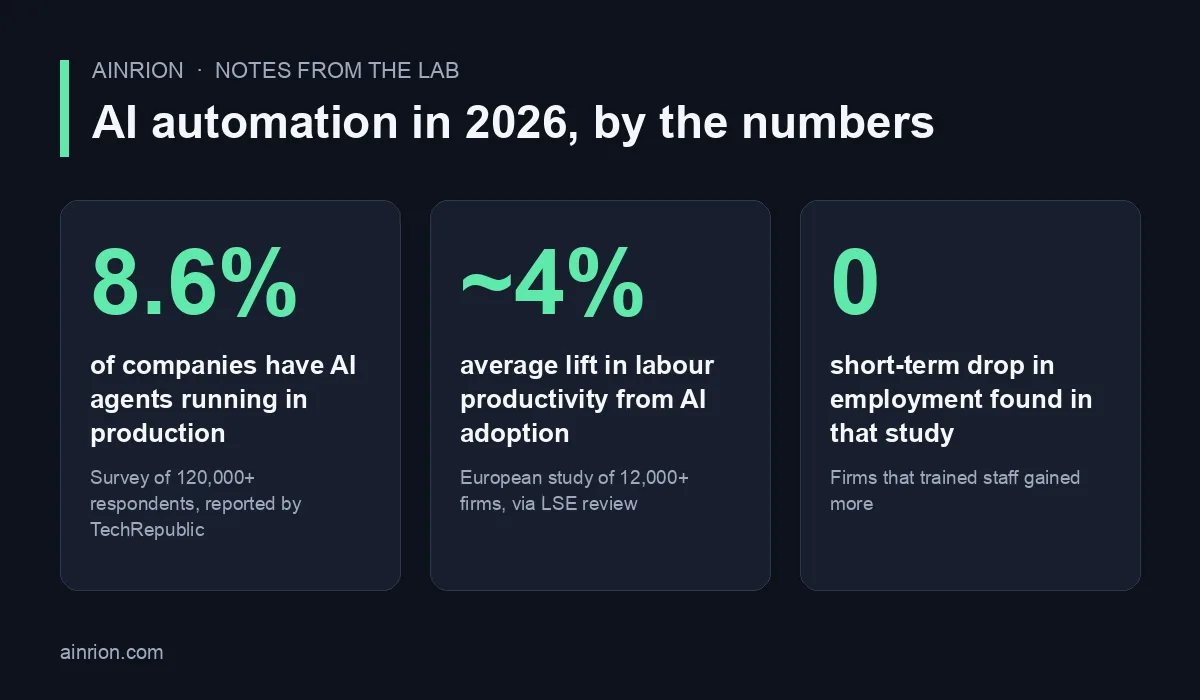
Most companies are still testing. Vendor surveys say most enterprises are "using or testing" agents. For AI agents for business, the real picture is more modest. A much larger survey of more than 120,000 respondents, reported by TechRepublic, found only 8.6% have agents running in production. The gap between a demo and a system your team relies on is still wide.
The gains are real, and modest. A European study of more than 12,000 firms found AI adoption lifts labour productivity by about 4% on average, with no short-term drop in employment. Firms that invested in training their people got noticeably more. The detail is in the LSE review of the evidence.
The biggest upside may be outside big tech. The World Bank's 2026 World Development Report argues that small, cheap, locally adapted AI tools in clinics, classrooms, farms and offices could compress decades of progress, provided the basics of power, connectivity and skills are in place. DevelopmentAid has a summary.
Trust is now the bottleneck. The things slowing AI automation are not model quality. They are questions like: what can this agent touch, who can see the data, and what happens when it gets something wrong?
The one automation to build first
If you only build one thing, build an enquiry-to-booking assistant.
Every business that sells a service loses money in the same place: the gap between a customer asking and someone answering. The assistant closes that gap.
Some people call it an AI receptionist. It does four things:
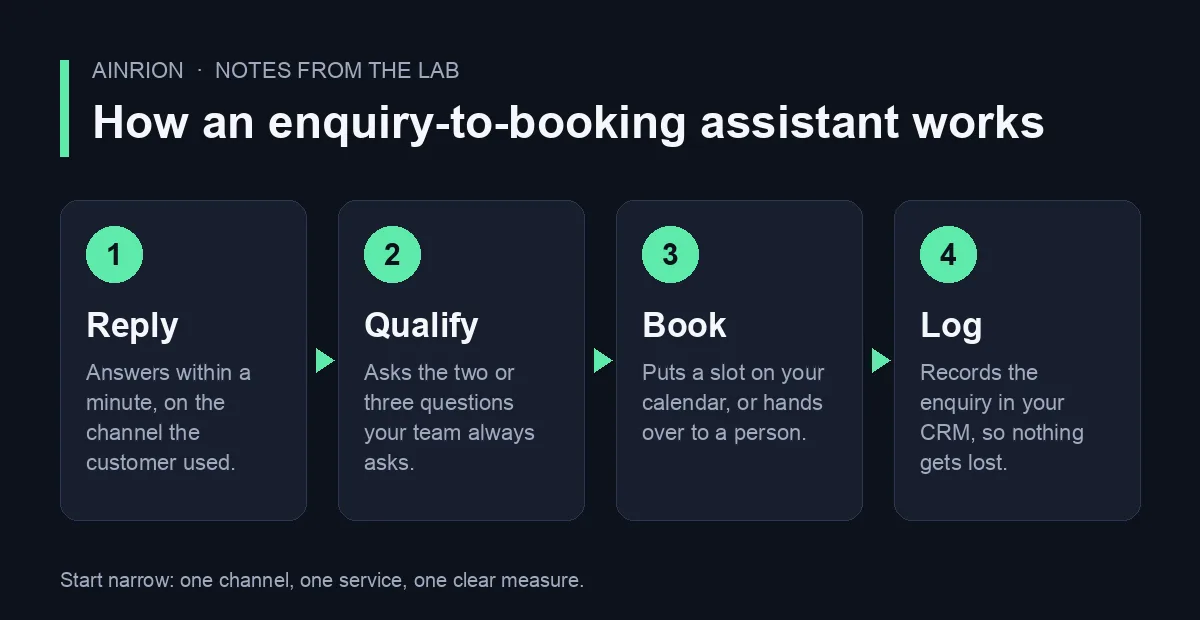
- Replies within a minute, on the channel the customer used: WhatsApp, email, a web form or SMS.
- Asks the two or three questions your team always asks: what they need, when, and their budget or location.
- Books a slot on your calendar, or hands over to a person when the request is unusual.
- Logs the enquiry in your CRM, so nothing lives in someone's inbox.
A simple version of this AI automation needs only four parts: a workflow tool to connect the steps, a language model to read and draft, your messaging channel, and your calendar and CRM. A first working version can be live in a few weeks.
Start narrow. One channel, one service, one clear measure: how fast you reply and how many enquiries turn into bookings.
The part most people skip: where it lives
An enquiry assistant reads customer names, phone numbers and sometimes health, property or financial details. That makes the setup matter as much as the features.
Four questions to ask before you switch one on:
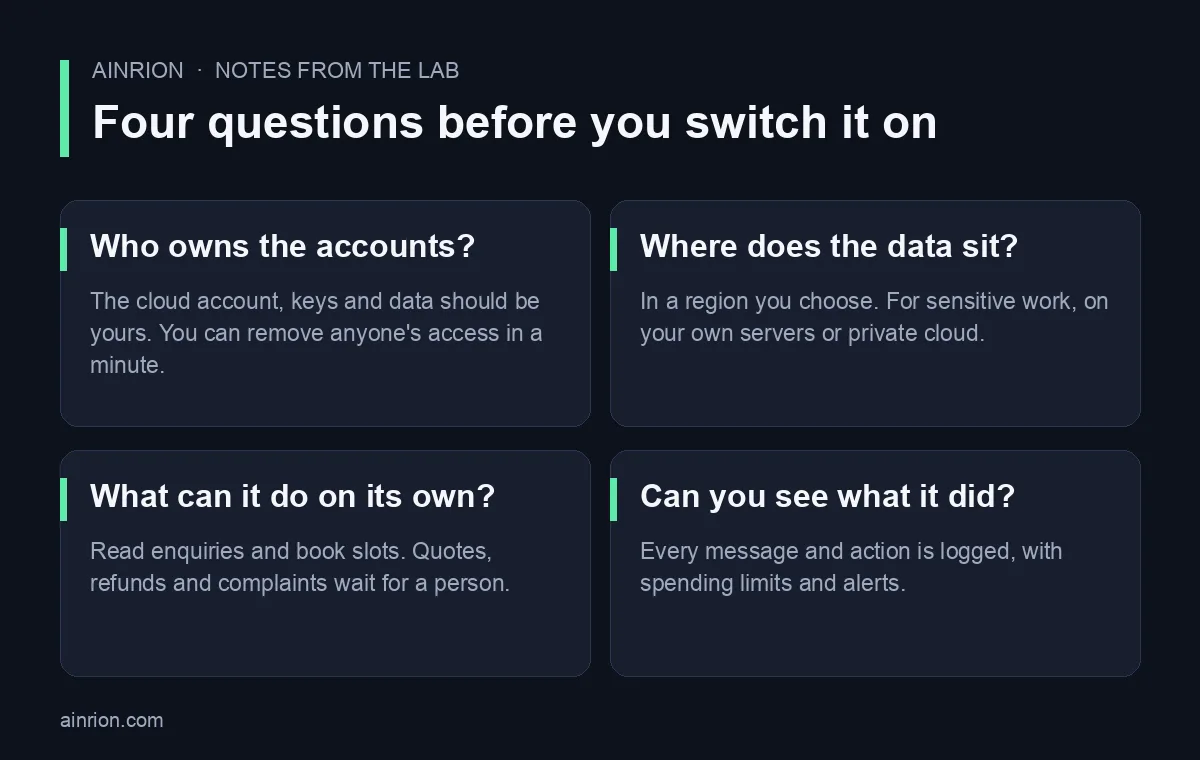
- Who owns the accounts? The cloud account, the keys and the data should be yours, not your vendor's. You should be able to remove anyone's access in a minute.
- Where does the data sit? It should stay in a region you choose. For sensitive work, the model itself can run on your own servers or private cloud, so customer data never leaves your environment.
- What can it do on its own? Reading an enquiry and booking a slot is fine. Quotes, refunds and complaints should wait for a person to approve.
- Can you see what it did? Every message and action should be logged, with spending limits and alerts so a mistake or a leaked key cannot run up a bill.
None of this is exotic. It is the difference between AI automation you can show your customers and one you hope they never ask about.
If you sell in the UAE, the US or Australia
The assistant is the same everywhere. The rules around it are not.
- UAE: a federal personal data protection law applies, the DIFC and ADGM free zones have their own regimes, and WhatsApp messaging needs customer opt-in.
- United States: rules vary by state and by sector. Healthcare data carries its own obligations, and marketing texts and calls need consent.
- Australia: the Privacy Act covers how personal information is handled, including telling people about serious breaches, and the Spam Act covers commercial messages.
This is a starting map, not legal advice. The practical point is simple: if your data stays in your own environment and every action is logged, most of these conversations get much easier.
Where to start
Pick the one place AI automation would pay for itself first: where enquiries leak today. Measure your current reply time for a week. Then build the smallest assistant that fixes it, in an environment you control.
That is the work we do at Ainrion: a fixed quote before you commit, a first working system in three to four weeks, and private deployment on your own servers or cloud when the data calls for it.
Book a free 30-minute call and tell us what eats your team's week.