This is a speculation piece about AI in 2027. Nobody knows exactly what next year looks like, including us. But the direction is visible in what is already shipping, and one change matters more to a business owner than any new model: the buyer on the other end may stop being a person.
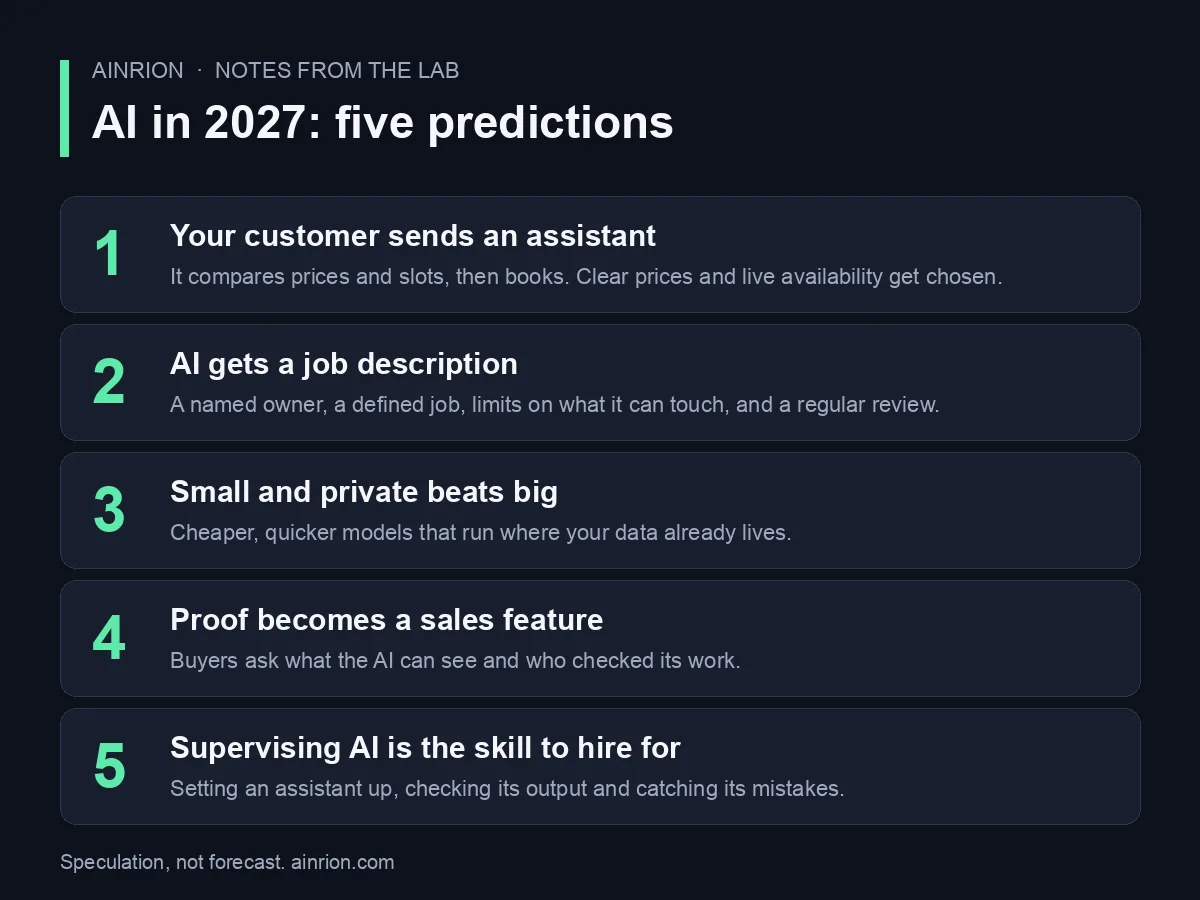
1. Your customer sends an assistant instead of a message
Phone assistants have started booking tables and placing orders on their owner's behalf. Follow that line for twelve months. A customer says "find me a physio near the office on Thursday evening," and their assistant checks five clinics, compares prices and slots, and books one.
It never sees your logo, your office or your sales pitch. It reads your prices, your availability and your reviews, and it decides in seconds.
Our guess for AI in 2027: businesses with clear prices, live availability and a way to book without a phone call get chosen. Businesses that say "call us for a quote" get skipped, and never find out why.
2. AI gets a job description
Today most companies are still experimenting. One large survey, reported by TechRepublic, found only 8.6% have AI agents running in production.
We expect that number to climb fast, and the companies that get there to treat an agent like a new hire: a named owner, a defined job, a list of what it may and may not touch, and a regular review. "We use AI" will sound as vague as "we use computers."
3. Small and private beats big and impressive
The headlines go to the largest models. The daily work will go to smaller ones that are cheap, quick, and run where your data already lives.
The World Bank's 2026 development report makes the same bet for whole economies: low-cost, locally adapted tools matter more than frontier systems. DevelopmentAid has a summary. For a business, that means predictable monthly costs and customer data that stays on your own servers or private cloud.
4. Proof becomes a sales feature
When an AI acts for your company, your customers will ask what it can see, where their data goes, and who checked its work. In 2027 we expect those questions to show up in ordinary sales conversations, not only in enterprise procurement.
The business that can answer in one page wins the deal: the data stays here, the assistant can do these three things, a person approves the rest, and every action is logged.
5. Supervising AI becomes the skill to hire for
The evidence so far says AI raises productivity modestly, and raises it more in firms that train their people. The LSE review of the research covers this. It also shows early-career hiring slowing in the roles most exposed to AI.
Our read: with AI in 2027, the valuable employee is the one who can set an assistant up, check its output and catch its mistakes. That is a skill you can teach your current team now.
The bet we would not make
The business that runs itself. Money, complaints and anything unusual will still need a person in 2027. The companies that remove people from those moments will produce the cautionary tales everyone else learns from.
How to prepare for AI in 2027
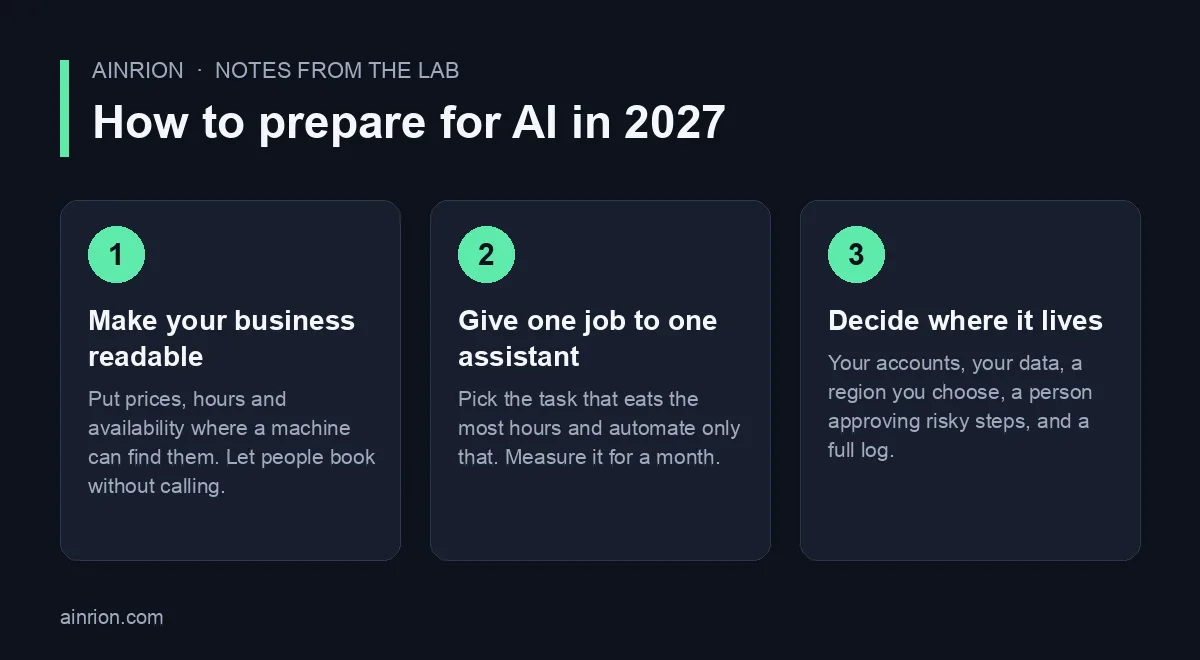
- Make your business readable. Put prices, opening hours and availability where a machine can find them, and let people book without calling.
- Give one job to one assistant. Pick the task that eats the most hours, such as answering enquiries, and automate only that. Measure it for a month.
- Decide where it lives. Your accounts, your data, a region you choose, a person approving the risky steps, and a log of everything it does.
We could be wrong on the timing. We doubt we are wrong on the direction.
At Ainrion we build these systems for growing businesses: a fixed quote before you commit, a first working system in three to four weeks, and private deployment when the data calls for it. Book a free 30-minute call and tell us what eats your team's week.