We pulled a year of AI search trends from Google to see what people and businesses want from AI as 2027 approaches. The short version: people search for work, businesses search for service, and almost nobody searches for building it safely.
How to read these AI search trends
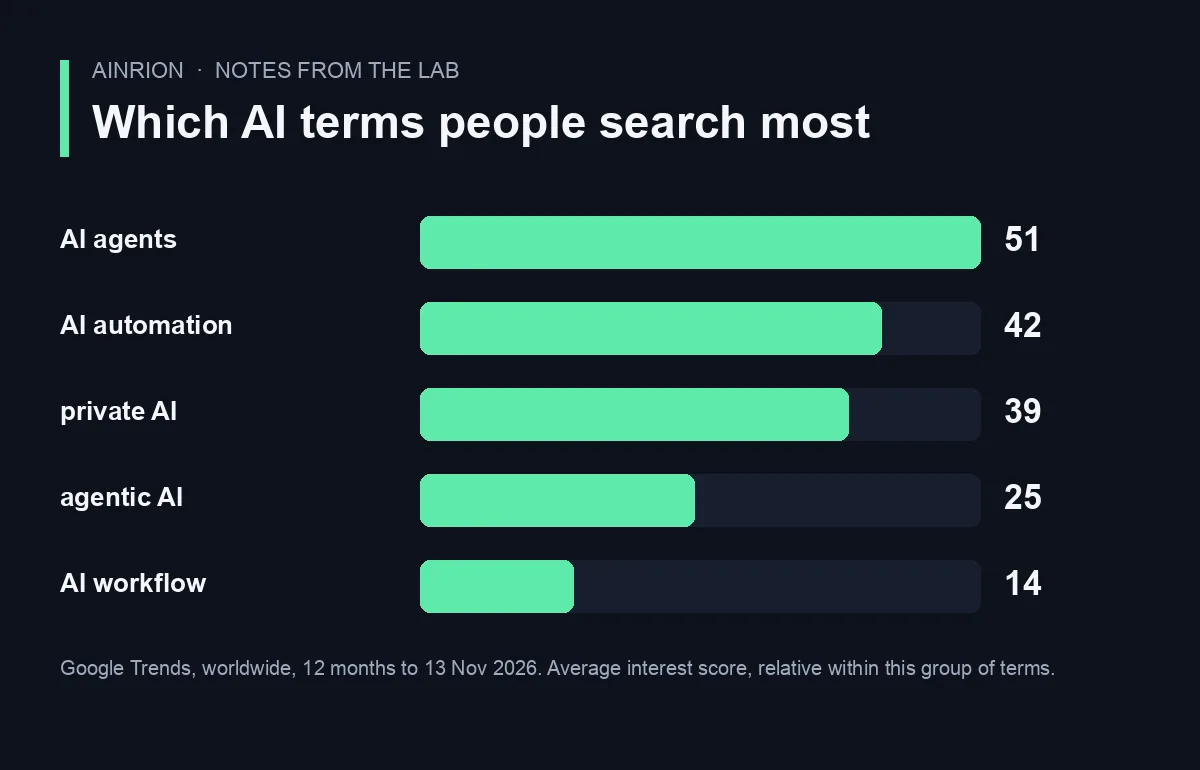
Google Trends scores are relative. Each number compares a term with the others in its group, on a scale of 0 to 100. So we read rank and share, not volume.
We also ignore the overall rise and fall through the year. In our check, unrelated terms such as "yoga" and "car insurance" moved the same way, so that movement tells us nothing about AI.
What people want
In the careers group, "AI jobs" averaged 36. "AI course" averaged 14, "AI skills" 10 and "learn AI" 6. A year ago, jobs and courses were close. Now jobs leads clearly.
People are looking for the work itself more than the classroom.
What businesses want
In the business group, "AI customer service" led at 32, ahead of "workflow automation" at 18 and "AI for small business" at 11. In a separate group of buyer phrases, "AI receptionist" came first at 48, then "AI agents for business" at 40.
The pattern is specific jobs over general ideas. Owners search for the role they want filled: someone to answer, book and follow up.
What almost nobody searches for yet
"AI coding" averaged 51 in its group. "Secure coding" averaged 2. "AI security" is the biggest term in the safety group, but "on premise AI" was too small to register.
Interest in building with AI is far ahead of interest in building it safely. We expect that gap to close in 2027, and for some firms it will close the hard way.
Where interest is strongest
Google also ranks countries by how large a share of local searches a term takes. The lists differ a lot from term to term.
- "AI automation" ranked highest in Nigeria, Pakistan, the Philippines and Bangladesh.
- "AI receptionist" ranked highest in New Zealand, Canada, Australia and the United Kingdom.
- "AI security" ranked highest in Pakistan, Mexico, Israel, Nigeria and India.
One possible reading: where staff are expensive, owners search for a role to fill. Where many people sell services online, they search for the skill itself. We hold that loosely. The lists show interest, not spending.
What changed over the year
Levels are hard to trust, so we looked at share within each group instead. Five movements stood out.
- "AI agents" and "agentic AI" gained share. "Private AI" lost it.
- "AI receptionist" gained share among buyer phrases.
- "AI jobs" pulled ahead of "AI course".
- "Local LLM", meaning a model you run yourself, gained share among safety searches.
- "Vibe coding" gained share among building searches.
The common thread is a move from ideas to actions. People are past asking what AI is. They are asking how to hire it, run it and work beside it.
What these AI search trends cannot tell you
Search data has limits, and it is better to state them than to hide them.
- It is relative. A score of 50 does not mean a number of searches. It means half the peak within that comparison.
- Searching is not buying. Curiosity runs well ahead of budgets.
- It is noisy. Some of the "related searches" Google returned had nothing to do with AI at all.
- Worldwide numbers hide local detail. Your own market may look different.
Treat AI search trends as a map of curiosity. They tell you which questions are forming in people's minds, and in what words. That is useful when you decide what to build, and how to describe it.
How to describe what you sell
If buyers search for a role, describe a role. "An assistant that answers enquiries and books appointments" will be found and understood. "An AI-powered engagement platform" will not. The AI search trends above suggest plain job descriptions win.
What to do with this
- Name the job. Buy or build an assistant for one task, such as answering enquiries, not "AI" in general.
- Decide where the data lives first. Your accounts, a region you choose, and a log of every action.
- Keep a person on the risky steps. Money, complaints and anything unusual still need a human.
These AI search trends point one way: 2027 rewards businesses that are specific about the job and careful about the setup. Our earlier post covers the one automation to build first.
Data: Google Trends, worldwide web search, 12 months to 13 November 2026. Scores are relative within each comparison group, so read them as rank, not volume.
Want help turning AI search trends into a working system? Ainrion builds AI-integrated software with security designed in: automation, development and deployment in an environment you control, with a fixed quote before you commit. Book a free 30-minute call.