AI security is the most-searched safety topic in our Google Trends comparison, and we expect it to become a routine sales question in 2027. Before a customer lets your assistant read their details, they will want to know what it can see and where the data goes.
What the AI security searches show
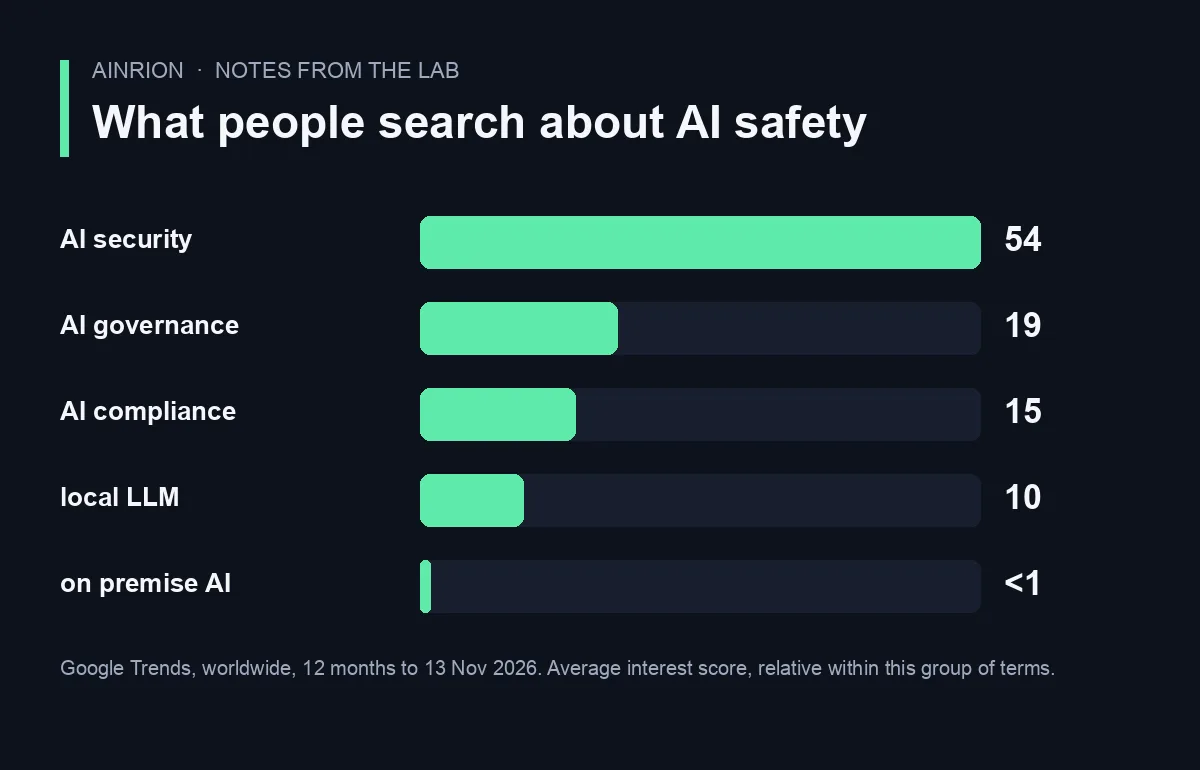
"AI security" averaged 54 in its group over the past twelve months. "AI governance" averaged 19, "AI compliance" 15 and "local LLM" 10. "On premise AI" was too small to register.
Within the group, "local LLM" and "AI governance" gained share over the year. One rising related search was simply "what is AI governance".
Our reading: people start with a broad worry, then move to practical questions about rules and about running models themselves.
Four answers to have ready
- What can it access? Each assistant should reach only the data its task needs, and nothing else.
- Where does the data live? In accounts you own, in a region you choose. For sensitive work, on your own servers or private cloud.
- Who approves risky actions? A named person signs off on money, refunds and anything unusual.
- What is the record? Every message and action is logged, and someone reads the log.
Why this arrives in 2027
A large survey reported by TechRepublic found only 8.6% of companies had AI agents in production. As that number grows, more assistants will hold real permissions: inboxes, calendars and payment tools.
Each one is a new door into the business. At that point AI security stops being a specialist topic. It becomes part of buying software.
Where AI security goes wrong in practice
Most problems are not clever attacks. They are ordinary shortcuts taken during a busy week.
- Keys saved in a file. A password or access key sits in a shared document or in the code itself.
- Too much access. The assistant can read the whole inbox when it needs one folder.
- No spending limit. A loop or a leaked key runs up a bill before anyone notices.
- A log nobody reads. Everything is recorded, and nothing is reviewed.
- Real data in testing. Customer records are copied into a trial tool and forgotten.
None of these needs a specialist to fix. Each needs someone to own it.
What governance means for a small firm
"AI governance" sounds like a department. For a small firm it is three written decisions.
- Which tools staff may use with customer data. A short list, kept up to date.
- Who owns each assistant. One name per system.
- What happens when one gets something wrong. Who is told, who fixes it, and who tells the customer.
Write those down and you have more governance than most firms your size.
How to answer a customer in two minutes
When a customer asks about AI security, they are not asking for a technical paper. They want a clear, short answer. Something like this works:
Your details stay in our own accounts, in a region we chose. The assistant can read enquiries and book appointments. A person approves anything else. Every action is logged, and we review the log.
If every sentence in that answer is true for your business, say it. If one is not, that is the next thing to fix.
What it costs
Mostly time. A few hours to write the page. A regular slot to read the logs. A habit of asking "what can this reach?" before switching anything on.
Adding these controls at the start is cheap. Adding them after a mistake, with customers watching, is not.
A five-question self-check
Answer yes or no for each assistant you run.
- Can you name the person who owns it?
- Could you list everything it can read and change?
- Is there a spending limit, with an alert?
- Did someone read its log in the last seven days?
- Could you switch it off in under a minute?
Five yes answers put you ahead of most firms. Each no is a small job for this month, not a crisis. Good AI security is built from small jobs like these, done on time.
Start with one page
You do not need a security team to begin. Write one page that answers the four questions for each assistant you run. If you cannot fill it in, that is the finding.
AI security done this way is mostly ordinary discipline: narrow permissions, clear ownership, and logs that someone reads. Our guide to the first automation to build walks through the same questions.
Data: Google Trends, worldwide web search, 12 months to 13 November 2026. Scores are relative within each comparison group, so read them as rank, not volume.
Need that one page written for your systems? Ainrion builds AI-integrated software with security designed in: automation, development and deployment in an environment you control, with a fixed quote before you commit. Book a free 30-minute call.