AI agents are the most-searched term in our core Google Trends comparison, ahead of "AI automation" and "private AI". Interest is not the problem. Getting AI agents from a demo into daily use, safely, is.
What the searches say about AI agents
"AI agents" averaged 51 over the past twelve months. "AI automation" averaged 42, "private AI" 39, "agentic AI" 25 and "AI workflow" 14. Across the year, "AI agents" and "agentic AI" gained share within the group.
Yet a survey of more than 120,000 respondents, reported by TechRepublic, found only 8.6% of companies have agents in production. Many are curious. Few have shipped.
Why demos stall
A demo runs on sample data, with full access, and nobody watching the bill. A real system touches customer records, needs permission to act, and makes mistakes at two in the morning.
The work between the two is deployment. It is less exciting than the demo, and it decides whether the project survives.
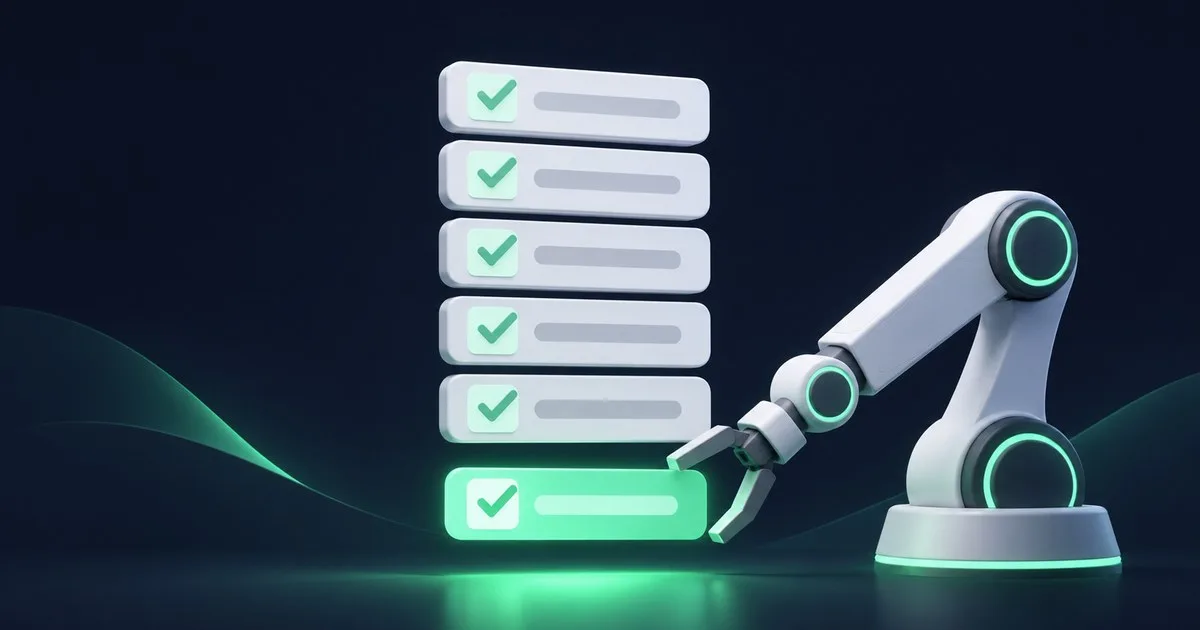
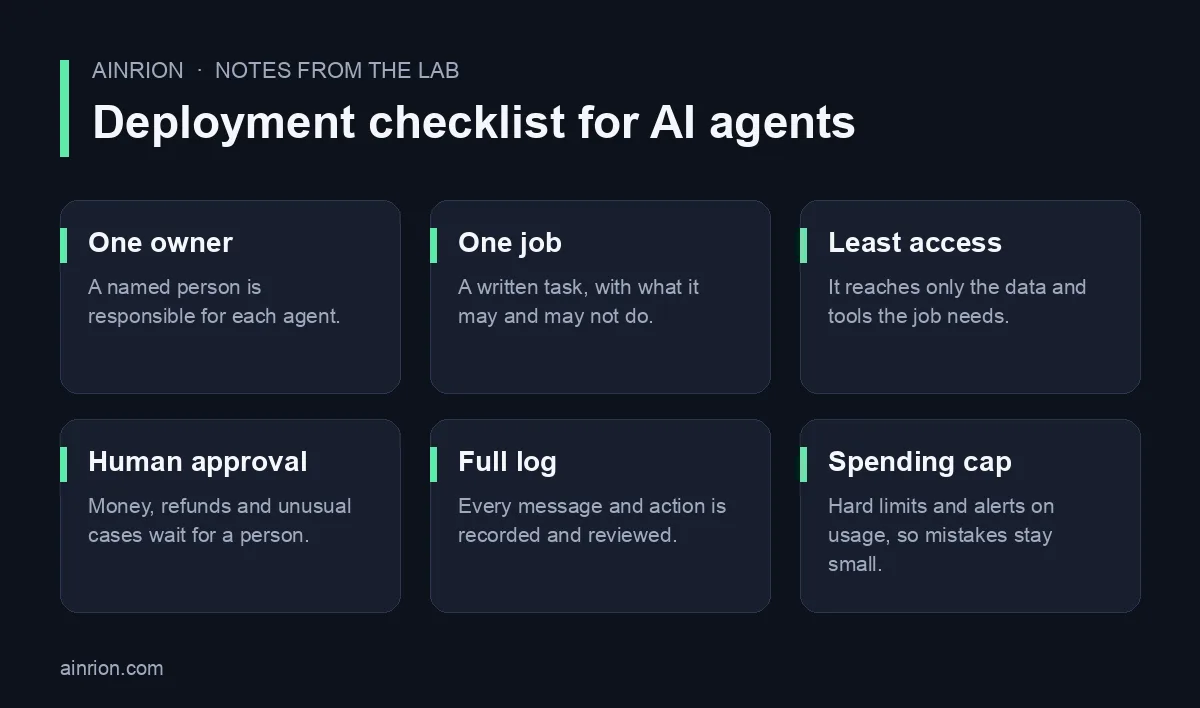
A six-point deployment checklist
- One owner. A named person is responsible for each agent.
- One job. Write down the task, and what the agent may and may not do.
- Least access. It reaches only the data and tools the job needs.
- Human approval. Money, refunds and unusual cases wait for a person.
- Full log. Every message and action is recorded, and someone reviews it.
- Spending cap. Hard limits and alerts on usage keep mistakes small.
What an agent is, in plain terms
An agent is software that is given a goal and some tools, and decides the steps itself. A chatbot answers. An agent acts.
Take a new enquiry. The agent reads it, checks the calendar, books a slot, writes the confirmation and logs the lead. Nobody told it each step. That freedom is the benefit, and it is also the reason deployment matters.
Three places AI agents earn their keep first
- The enquiry desk. Replying, qualifying and booking, at any hour.
- Follow-ups. Chasing quotes that have gone quiet, on a schedule nobody forgets.
- Back-office reports. Pulling numbers from accounts and spreadsheets into one weekly summary.
All three share the same features. The task repeats, the rules are clear, and a mistake is easy to spot and cheap to fix.
How to run a pilot that can become production
Many pilots are built in a way that cannot be shipped. They use sample data and broad access, so everything must be redone later. A better pilot looks like production from day one, only smaller.
- Use real permissions, kept narrow. Give the agent the access it will have when live, and no more.
- Keep the data in your own environment. Do not copy customer records into a trial tool.
- Pick one number. Reply time, bookings or hours saved.
- Review every action for the first weeks. Loosen the approvals only where the agent has earned it.
Signs an agent is not ready
- Nobody can say who owns it.
- It needs administrator access to work.
- No one has read its log this week.
- The monthly cost came as a surprise.
Any one of these is a reason to pause. AI agents fail quietly more often than they fail loudly, and the log is where you find out.
Who should be in the room
Deployment fails when it is left to one enthusiast. Four people should agree before an agent goes live.
- The owner. The person who will answer for it.
- The person who does the task today. They know the exceptions nobody wrote down.
- Whoever looks after your systems. They decide what access is safe.
- Someone who can say no. A manager with the authority to delay launch.
In a small firm, two people may cover all four roles. That is fine, as long as each role is covered by someone.
What skipping deployment costs
The cost rarely shows up on launch day. It shows up weeks later, as a wrong booking, a reply that should not have been sent, or a bill nobody expected. By then customers have seen it. Doing the checklist first is the cheaper order.
What we expect in 2027
We expect buyers to ask for a checklist like this before they sign. Vendors who can show one will move from pilot to production faster, because the client's IT and legal teams have fewer reasons to say no.
For most businesses the right first step is still small: one agent, one job, in an environment you control. Our guide to the first automation to build shows what that looks like.
Data: Google Trends, worldwide web search, 12 months to 13 November 2026. Scores are relative within each comparison group, so read them as rank, not volume.
Ready to move AI agents from demo to production? Ainrion builds AI-integrated software with security designed in: automation, development and deployment in an environment you control, with a fixed quote before you commit. Book a free 30-minute call.